Katherine Xu / AI product engineer & product manager
I turn human expertise and messy workflows into useful AI products.
I talk to users, write the code, and design the evals that show whether an AI product actually helps, drawing on software development, psychology, and learning science.
Open to AI product engineer, forward deployed engineer & AI product manager roles

Based in the San Francisco Bay Area
Currently at VEGAMaking expert knowledgework in AI workflows.Explore Agentize
From questions to working systems
Selected work.
interviews
points
judgment
Agentize
Turning expert interviews into structured decision points for sales-training agents, with a workflow for human review and refinement.
Product specs, API contracts & review workflow design
- Product
- API design
- Evals
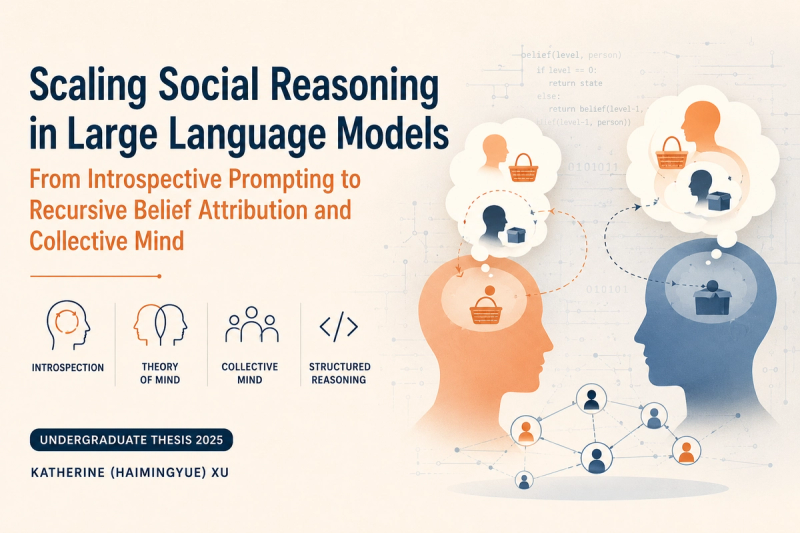
Scaling Social Reasoning in LLMs
Testing where LLMs lose track of what people know and believe, and how reasoning structure changes their performance.
Experiment design, model evaluation & analysis
- Research
- Evals
- Prompting

Aligned
Helping student teams turn scattered course requirements into a shared plan, starting with AI syllabus extraction.
User research, production deployment & landing site
- Product
- User research
- Deployment
A little about how I work
Start with people.
Build, question, refine.
I’m interested in the gap between what an AI system can generate and what a person can actually use.
Software development helps me reason about systems. Psychology makes me curious about how people think. Learning science pushes me to ask what useful support looks like and how we would recognize it.
Understand the human part
Find the knowledge, needs, and workarounds a useful product has to start with.
From expert interviews to usable knowledge02Define the right structure
Turn a fuzzy problem into clear workflows, useful constraints, and deliberate scope choices.
A syllabus becomes a shared plan03Learn from the limits
Use experiments and feedback to understand what works, where it breaks, and what to change.
Testing the limits of LLM social reasoningAnother side of my practice
Perspective & possibility.

Where I’ve been working
Experience
Founding Product Manager
VEGA
Lead product for Agentize and the AI Marketplace. I write PRDs and API contracts with engineering and implement frontend features. I set up CI/CD from GitHub to AWS EC2 and connect the application to Neon PostgreSQL.
Research Assistant
Harvard Graduate School of Education · Arcs of Justice
Design the CMS taxonomy and content architecture, and implement 20+ research webpages for Arcs of Justice.
Bot Club Student Partner
Harvard Graduate School of Education · LEAP
Developed an AI agent with a faculty partner to support feedback on students’ venture ideas.
Instructor & Subject Interviewer
HD Education
Taught introductory computer science and Japanese to 1,300+ students, designing 25+ curricula that turn technical ideas into steps a beginner can follow.
Notes from the work
Thinking out loud.
Apr 2026
I asked an AI to interrogate my startup idea. Here's what honest product thinking actually feels like.
Two hours with an AI advisor, a product I thought I understood, and a few questions I couldn't dress up.
Read essayMar 2026
What My LLM Research Taught Me About Building AI Products That Actually Work
What testing LLM social reasoning taught me about task structure, model limits, and better product decisions.
Read essay