Aligned
View project ↗A lightweight project hub for MBA student teams. AI-powered syllabus analysis extracts every deadline and deliverable from a PDF in under 10 seconds, synced to a shared timeline.
Overview
Aligned is a lightweight project hub for MBA student teams, built to eliminate the coordination tax of scattered tools, forgotten deadlines, and unclear ownership. It sits on top of the tools teams already use, with AI-powered syllabus analysis at its core. The landing page is live at aligned-teams.org.
The Problem
Student project teams at top MBA programs carry a coordination tax that rarely feels dramatic enough to fix, but compounds constantly. Deadlines live in course syllabi that nobody re-reads after week one. Action items get assigned in group chats and forgotten by the next morning. Scheduling a single meeting takes a dozen messages across WhatsApp, iMessage, and email.
What makes this hard to solve is that teams don't experience it as a crisis. They experience it as friction. Coordination cost is treated as normal: repeated small delays that add up, waiting for replies, re-making decisions, losing information across apps, and unclear ownership before deadlines.
Existing tools don't solve it. Notion, Asana, and ClickUp get introduced at the start of a project and abandoned within a day because the setup cost exceeds the perceived benefit for a four-week academic project. The gap is the absence of a coordination layer across all of them.
Customer Research
Five in-depth interviews with MBA and undergraduate students revealed consistent patterns across all teams, regardless of how organized they considered themselves to be.
- →One person always becomes the unofficial coordinator, tracking deadlines, sending reminders, and keeping the team moving without any formal mandate. When that person is overwhelmed, things fall through the cracks.
- →Meeting notes, decisions, and action items are chronically hard to retrieve. Even teams using both Notion and Google Docs couldn't consistently find what was decided in last week's meeting. Scattered is functionally the same as missing when you're working to a deadline.
- →Scheduling friction was cited in nearly every interview as a recurring high-cost task. One interviewee quantified it directly: roughly 30% of time in the final week alone was spent on coordination rather than the work itself.
The clearest throughline: students don't want another full platform. They want a simple layer that organizes what already exists.
The Solution
Aligned is a lightweight coordination hub that sits on top of the tools teams already use. It doesn't ask teams to migrate their documents, switch their chat app, or learn a new workflow. Instead, it connects everything (Slack, WhatsApp, Google Drive, Notion, and Figma) into a single project view findable in one place from the moment the project starts.
The flagship feature is AI-powered syllabus analysis. A team member uploads a course syllabus PDF, and Claude parses the unstructured document to extract all deadlines, deliverables, and grading weights, automatically populating a shared project timeline in under 10 seconds. For a team seeing the product for the first time, this is the moment it clicks.
Everything else is designed around the same constraint: setup must take minutes, not hours. Every feature is optional. A team can get immediate value just by creating a project and sharing the invite link.
Features
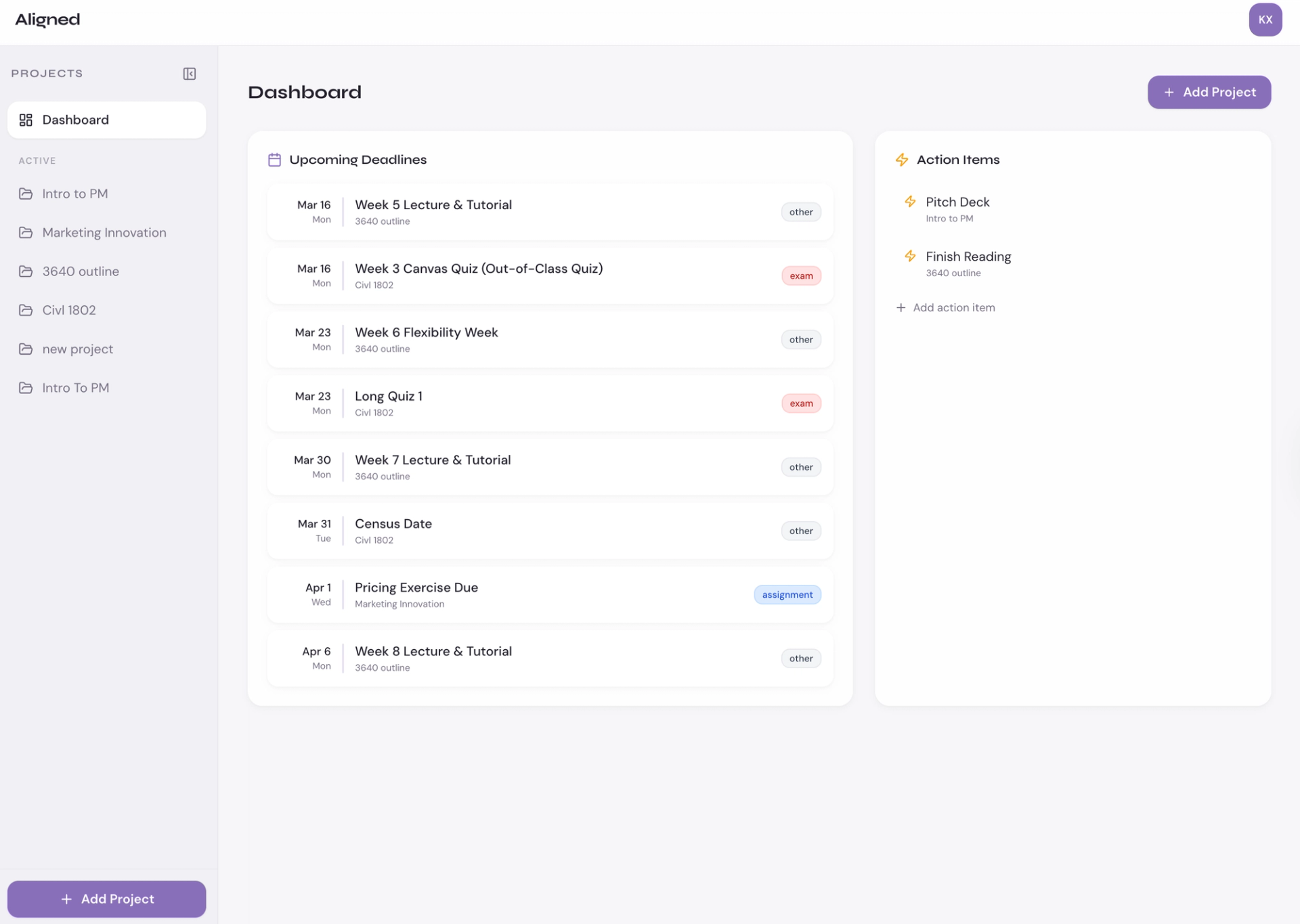
AI Syllabus Analysis uploads a course syllabus PDF and Claude automatically extracts every deadline, deliverable, grading weight, and milestone to populate the shared project timeline. Designed as the product's aha moment: the first feature that makes Aligned feel immediately, concretely valuable.
The Document Organizer and Communication Channel Hub lets teams link external documents and repositories (Google Drive, Notion, Figma, GitHub, and Dropbox) with editable labels in one place. Existing communication channels (Slack, WhatsApp, Discord, iMessage, Zoom, and Teams) are linked directly into the project.
Project Invite Links are auto-generated for every project. One click, no email invitation required, no admin approval. Works for users who haven't signed up yet: clicking the link redirects to registration, then auto-joins the project. The primary growth mechanism: every new project brings in two to four new users organically.
Action Items is a shared to-do list where any team member can add, complete, or remove items. Changes sync in real time across all connected members via Server-Sent Events. Directly addresses the most common interview finding: action items assigned in chat and forgotten by the next day.
The Team Member Directory lists all project members with name, email, role, and custom tags. Surfaces contact method and responsibility at a glance, especially valuable for newly formed teams with no established norms.
Technical Build
- →Frontend: React + Vite + Tailwind CSS with a lavender and purple design system and glassmorphism-lite card components
- →Backend: Express.js REST API with session-based authentication via Passport.js
- →Database: PostgreSQL hosted on Supabase, managed with Drizzle ORM; sessions persisted via connect-pg-simple
- →AI: Anthropic Claude API for syllabus parsing: unstructured PDFs in, structured deadline data out
- →Real-time: Server-Sent Events for live action item sync across all connected team members
- →Deployment: Vercel, two projects from a single monorepo with a landing page at aligned-teams.org
Traction
Piloted with an initial cohort through MIT course 15.785. Every pilot user rated the product simple to use and expressed intent to continue using it beyond the course, an early signal that the core value proposition landed.
The interview-driven 30% coordination tax figure, the pattern of PM tools being tried and abandoned, and the universal desire for a coordination layer rather than another workspace all shaped the product decisions that made it to the MVP.
Market
The immediate target is first- and second-year MBA students at Harvard Business School and MIT Sloan, where students typically run two to four group projects simultaneously per semester. The tight cohort structure makes it a strong word-of-mouth environment. A product that works for one team spreads quickly within a class.
The broader TAM spans higher education globally. The secondary growth path is early-stage startup teams: small founding groups with the same tool fragmentation problem, longer project timelines, and slightly greater willingness to pay. The freemium model targets monetization after adoption, at \$5 to \$8 per month for AI syllabus analysis, with core coordination features remaining free.
Current Status
The landing page is live at aligned-teams.org, and the full app with all seven core features is available upon request.
Near-term priorities include improving first-session onboarding, optimizing the mobile layout, adding deadline reminders, and enabling optional action item assignment. Longer-term features in scoping include Google Calendar sync, availability-based meeting suggestions, and project templates by course type. The team is actively seeking a business-focused cofounder to lead fundraising and go-to-market.